
The Granularity Shift in Local Search
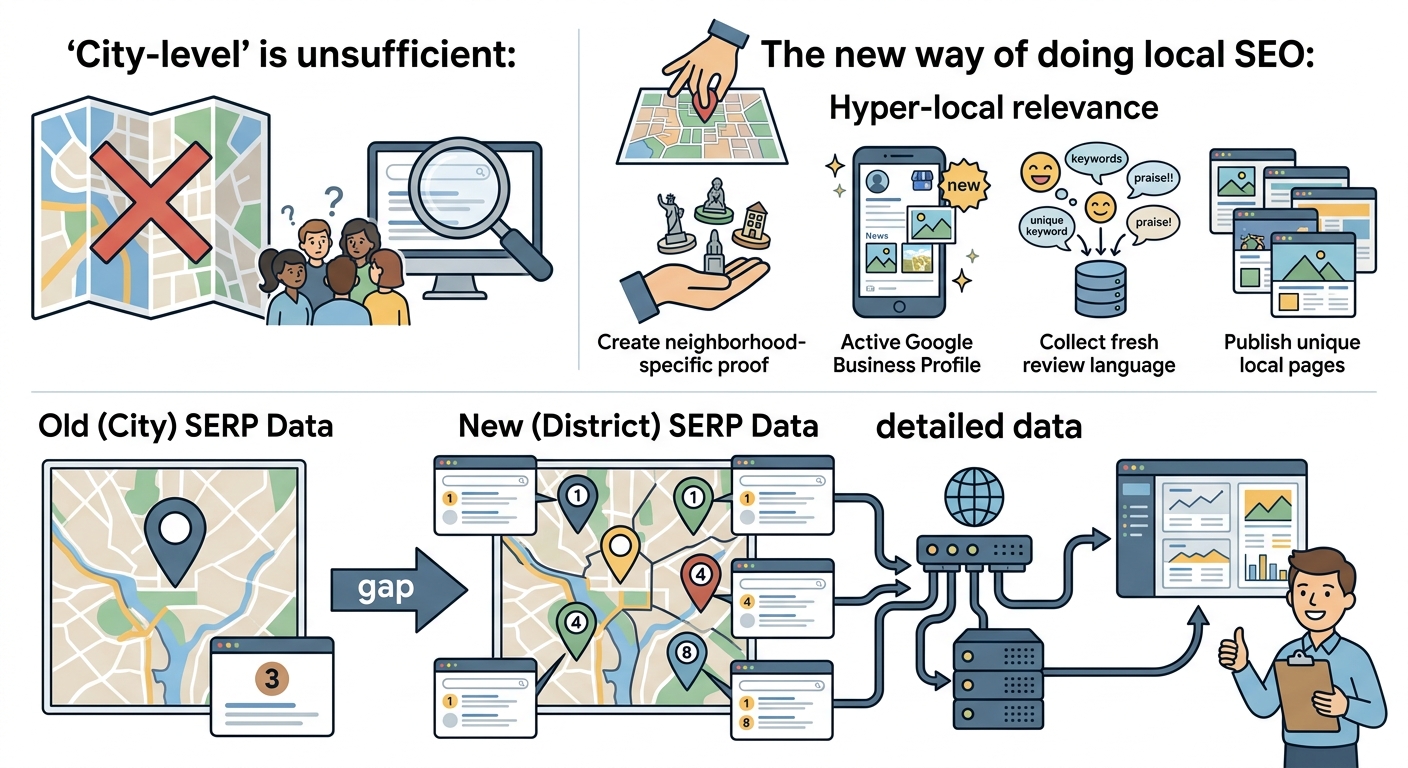
Build local depth at the district level if geography matters. Hyper-local SEO now rewards relevance over reach. Create neighborhood-specific proof, keep your Google Business Profile active, collect fresh review language, and publish local pages with real differences rather than duplicated copy.
The instruction to build local depth at the district level rather than city level is the most operationally specific advice in the June 2026 local SEO guidance — and it has direct implications for how SERP data needs to be collected by anyone doing serious local SEO research.
City-level SERP data is no longer sufficient for understanding local search performance when Google’s algorithms are evaluating district and neighborhood granularity.
A rank tracker that shows you ranking in position 3 for “event venue [city]” may be hiding that you rank in position 8 when the user is in a specific neighborhood and asking Ask Maps for nearby venues.
That granularity gap only becomes visible when you collect SERP data from multiple specific geographic locations within the city rather than a single city-level IP address.
How Proxies Enable District-Level SERP Intelligence
Residential proxies with city and district-level IP targeting are the infrastructure that makes district-level SERP monitoring possible for local SEO professionals.
A residential IP assigned to a specific neighbor hood in Mumbai produces different Google Maps and SERP results than a residential IP in a different neighbor hood of the same city — because Google’s local personalization engine is operating at that level of granularity.
For local SEO in Russia and for low block risks on Google and Yandex, mobile proxy space remains a best choice due to its mobile ASN, city, and carrier options. For international and enterprise cases, Bright Data and Oxylabs offer maximum flexibility and SLA.
The carrier option in mobile proxies is specifically valuable for local SERP research because carrier-level targeting allows researchers to simulate what a user on a specific mobile network in a specific location sees — which can differ from what a broadband home user in the same location sees, particularly for local pack results.
For agencies building district-level SERP intelligence programmes for clients, mobile proxies with carrier targeting are the most accurate available tool for capturing how Google’s location-aware results actually appear to real users.
💬 Reddit — r/LocalSEO and r/webscraping on district-level SERP monitoring: 🔗 https://www.reddit.com/r/LocalSEO/search/?q=district+level+SERP+monitoring+proxy+2026
🐦 X/Twitter — local SEO professionals discussing hyper-local rank tracking: 🔗 https://x.com/search?q=hyper+local+SEO+district+level+SERP+proxy+2026&f=live
💬 Quora — how to track local SEO rankings at neighbourhood level with proxies: 🔗 https://www.quora.com/search?q=local+SEO+neighbourhood+rank+tracking+residential+proxy+2026
Quick Links: